
Evo Aria Evo One - Standard Digital Sound Player











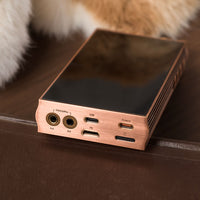









Evo Aria Evo One - Standard Digital Sound Player
Pre-order available. Delivery April 2026.
Only 199 units worldwide.
Reviews

"It is not a cheap product, raising the summit-fi price bar, but it also raised the performance bar relative to N30LE.
Still, even in the short time I had with its Ti and Cu versions, I was quite impressed by its technical performance and the amount and quality of its sound-shaping options within a DAP, allowing me to fine-tune the DAP’s sound to perfection with a few IEMs and headphones I tried."
First look: EvoAria Evo One DAP – Twister6 Reviews
Highlights
- Parallel differential DAC architecture based on two AK4191EQ modulators and four AK4499EXEQ DACs.
- Features a double-sided grille architecture that enables 27% more effective heat dissipation.
- Evo One Titanium is housed in a TC4 titanium alloy case with PVD coating (approx. 575 g), while Evo One Copper features a brass case with a vintage copper finish
(approx. 740 g) - Qualcomm QCS8550 platform (8 Gen 2-equivalent CPU) with 16 GB RAM, 512 GB internal storage, and support for microSD cards up to 2 TB
- Powered by Android 13.0 with full Google framework support and global DTA lossless audio output
- High-resolution local playback supporting up to PCM 768 kHz and DSD512 with MQA16× unfolding
- Equipped with a 5.99-inch BOE In-Cell FHD+ display (1080 × 2160, 18:9), protected by Corning Gorilla Glass 5, with multi-touch functionality, double-tap wake function, and intuitive gesture control
- Equipped with a 10,000 mAh / 3.87 V high-performance battery with a
Ultra-low-loss protection circuit, supports PD 3.0 fast charging with a peak power of up to 45 W (15 V/3 A) - Features Bluetooth 5.3, HiByCast Wireless Screen and Control, as well as Wi-Fi 7
Connectivity with support for multiple Bluetooth audio codecs, including UAT (up to 192 kHz), LDAC (up to 96 kHz), SBC, and AAC - Supports touch remote control via smartphone or tablet
- Provides three digital audio outputs, including USB audio, S/PDIF, and I²S with three
Pin assignment configurations -
Supports bidirectional USB audio input and output with USB audio output up to PCM768kHz and DSD512
Evo One Titanium (Ti)
Sound Character
Wide soundstage, strong dynamics, excellent transient response, outstanding extension at both frequency extremes, with a clear and well-layered presentation.
Evo OneCopper (Cu)
Sound characteristics
Excellent speed and transient response, wide and natural soundstage, rich overtones with deep, powerful, and textured bass.

Hardware and main features
Features a parallel differential DAC architecture based on two AK4191EQ modulators and four AK4499EXEQ DACs. Each AK4499EXEQ operates in MONO mode and uses a current output topology with an eight-channel I/V conversion stage for improved linearity and dynamic performance.
Uses two audiophile ADI AD8620ARZ operational amplifiers to form a four-channel LPF stage that offers a unique sound character with exceptional openness and transparency.
Uses two JRC flagship MUSES72320V volume control chips to create a
to form an ultra-low noise, parallel, fully symmetrical four-channel hardware volume and gain control system.
Equipped with two active quartz oscillators from the Accusilicon AS318 series (45.1584 MHz and 49.152 MHz) with extremely low phase noise and femtosecond precision.
The amplifier stage is made entirely of discrete components, including audio FETs and transistors, forming a pure semiconductor architecture. A classic three-stage topology is used, consisting of a fully symmetrical differential input stage, a voltage amplification stage, and a power driver output stage.
The local negative feedback is user-selectable (NFB / non-NFB), and the amplifier supports both Class A and Class AB operating modes. This flexibility allows the user to adjust the amplifier's operating characteristics to their personal listening preferences for optimal sound quality.
Triple analog audio architecture
Dual Tube Hybrid + One Fully Transistor
The design features a triple analog audio architecture, consisting of two tube-based hybrid modes and a fully transistorized (FULLY TR) mode, allowing users to tailor the sound character to different music styles and personal preferences.
Dual tube hybrid architectures
The hybrid circuit is based on two KORG NUTUBE 6P1 vacuum tubes, which together with the amplifier stage form a complete analog audio signal path.
The tube circuit consists of a buffer amplifier stage, a tube voltage amplifier stage, and a buffer driver stage.
The source-load stage uses independent junction FETs configured as constant current sources, significantly improving the current driving capability and the performance of the voltage follower.
By selecting different local feedback configurations, two distinct signal gain profiles are created, which shape the overall sound character
can be adjusted:
Velvet
A warm, velvety sound presentation with a more concentrated distribution of
even harmonics. Best suited for emotionally rich music with simpler
Arrangements and smoother dynamics.
Lumina
A clear, bright sound with strong definition and well-defined contours, characterized by a more even distribution of even harmonics. Offers greater versatility across a wide range of music genres.
In hybrid mode, the screen grid operating voltage of the 6P1 tubes can be switched between high (H) and low (L), allowing further fine-tuning of the listening experience through voltage adjustment.
Fully transistor architecture (FULLY TR)
In FULLY TR mode, the analog signal path completely bypasses the tube circuit and
operates as a pure, fully discrete transistor amplifier.
This configuration offers exceptional speed, dynamics, and transient response, making it especially suitable for classical symphonies, orchestral works, and OST recordings.
Features high-quality Line-Out (LO) and PRE-Out (PRE) outputs, both switchable between hybrid and FULLY TR circuit architectures.
This versatility facilitates the integration of the device into a variety of systems,
from desktop headphone amplifiers to car audio systems, enabling flexible system setups without compromising sound quality.
Exclusive battery bypass function: When Evo One is connected to an external DC power source
(e.g., a PD charger) is connected and the system detects an output voltage of ≥ 9 V, users can select the DC mode via the user interface.
In this mode, the battery is completely bypassed, so the device is powered directly from the external power supply – ideal for long-term stationary use while effectively protecting and extending battery life.
Power supply
Main power supply
The main power filter stage uses ELDC (Farad-level supercapacitors) with
extremely low ESR (equivalent series resistance) and extremely fast charge/discharge response.
Together with a strictly tuned "series-parallel" configuration of
10,000 mAh 3.87 V battery cells form the central power supply hub of the entire device.
This robust power supply foundation is the fundamental guarantee for the great
Dynamic range, expansive soundstage, high sound density, and detailed
Playback of the device.
FPGA and clock power supply
The FPGA is powered by three independent low-noise TI LDO regulators with
3.3 V, 1.8 V, and 1.2 V. The femtosecond clock module is powered by a special low-noise LDO regulation stage, ensuring maximum timing accuracy and extremely low phase noise.
DAC power supply architecture
The entire DAC power supply is based on the LT8334 from ADI, which provides a large
Input voltage range, high performance, high efficiency, and comprehensive protection functions combined.
A dual-mono power supply topology is used, independently powering the left and right channels, effectively reducing crosstalk between channels and noise coupling, ensuring excellent channel separation.
Each channel is equipped with multiple low-noise LDO regulators, with the core area equipped with the extremely low-noise LT3045 LDO from ADI to provide highly precise, Each channel is equipped with multiple low-noise LDO regulators, with the core area utilizing the extremely low-noise LT3045 LDO from ADI to supply the DAC core chip with highly precise, ultra-pure power.
This power-first approach ensures maximum decoding accuracy at the source.
In addition, the analog differential output reference voltage of the DAC is provided by 16
supported by parallel Panasonic polymer capacitors with low ESR, significantly improving power stability and transient response.
Power amplifier supply: Dual LT8334 architecture
The power amplifier stage is driven by two ADI LT8334 regulators, which precisely
Provide matched symmetrical positive and negative current rails and fully meet the operational requirements of the amplifier circuit.
Power filtering is realized through a highly efficient "main capacitor + parallel bypass" configuration:
The main filter capacitors are Panasonic solid capacitors with low ESR, offering excellent ripple suppression and effectively filtering power noise in the low and mid-frequency ranges.
In parallel, 12 Panasonic low-ESR polymer capacitors form a high-frequency bypass filter array, creating a comprehensive full-bandwidth power filtering system that significantly improves power purity and overall sound quality.
This advanced filter structure ensures immediate high-current supply at
large dynamic signal outputs and prevents voltage drops that would otherwise cause
could lead to dynamic compression or audio distortion.
At the same time, it significantly improves transient response, resulting in more powerful bass, finer high-frequency details, and a completely noise-free, artifact-free listening experience, guaranteeing uncompromising high-fidelity audio output throughout the entire signal chain.
Eight-layer ENIG PCB
An eight-layer ENIG (Electroless Nickel Immersion Gold) PCB is used to
to ensure high precision and signal stability.
Depending on the electrical and electromagnetic properties of titanium and copper, different routing designs are applied to effectively reduce interference and signal loss, ensuring clean, stable, and high-resolution audio performance.
Differences between Evo One Titanium & Evo One Copper
Evo One Titanium (Ti)
Evo One Ti is made from TC4 titanium alloy of aerospace quality and features a special PVD surface treatment that provides a smooth, warm feel and an elegant silver-white metallic finish.
In the PCB design, the EvoAria team employed first-level HDI technology and used blind vias to connect the power filtering ground, significantly shortening the current return paths and enhancing the overall ground continuity.
By optimizing and expanding the ground planes across multiple PCB layers, digital signals and audio signals are placed on separate inner layers, effectively improving shielding and eliminating interference.
The signal paths use ENIG precision impedance control with strict impedance matching to ensure fast, accurate, and stable signal transmission.
In the fully symmetrical differential analog amplifier stage, all current, ground, and signal paths are designed with precise length and symmetry matching, resulting in exceptional stability and a very open, transparent sound.
Sound Character
Wide soundstage, strong dynamics, excellent transient response, outstanding extension at both frequency extremes, with a clear and well-layered presentation.
Benefits
Lightweight, high strength, excellent scratch and wear resistance.
Considerations
Slightly lower heat dissipation performance. Fast charging capability is slightly limited compared to Evo One Copper (Cu), resulting in a somewhat longer charging time.
Evo OneCopper (Cu)
The brass chassis offers exceptionally high electrical conductivity and forms a powerful grounded shield that significantly reduces external electromagnetic interference and provides an extremely low impedance path.
Leveraging these features, the EvoAria team optimized grounding vias and direct ground plane connections during PCB layout, creating the shortest and most efficient ground return paths for digital audio signals, high-speed data lines, and clock circuits.
This allows digital noise to form a closed return loop through the chassis and ground plane, completely isolating digital interference from the analog audio circuits.
This gives the Evo One Cu excellent interference resistance and exceptional sonic purity.
Its analog circuits fully utilize the extremely low impedance path combined with ENIG precision impedance control, resulting in remarkably fast and powerful dynamic response.
Sound characteristics
Excellent speed and transient response, wide and natural soundstage, rich overtones with deep, powerful, and textured bass.
Benefits
Superior heat dissipation, higher charging efficiency, and about 30 minutes faster charging compared to the Evo One Titanium (Ti).
Considerations
Higher overall weight (740 g), about 165 g heavier than Evo One Ti.
The softer material requires careful handling; despite PVD coating and clear lacquer, the surface may be more prone to scratches, making portability somewhat less comfortable.
Internal structure, tube vibration control, and thermal management: Evo One features a precise multi-chamber interior that separates the battery, tube, and main circuit to minimize interference and preserve signal purity.
For tube vibration control, Evo One uses a fully enclosed silicone damping structure that effectively suppresses vibration-induced microphonics in the vacuum tubes, providing greater stability and finer sound reproduction.
The thermal management is based on a precise aluminum alloy support frame,
combined with graphene sheets, thermally conductive silicone, and nickel silver, creating a highly efficient heat dissipation system.
This design significantly improves overall cooling performance, allowing heat to be evenly distributed across the chassis and ensuring stable long-term operation with consistently high performance.
Specifications
Battery Life

Output power


